Menu
close

At first glance, Greece and Cyprus can seem almost identical. Both countries speak Greek, share the Orthodox Christian faith, enjoy a Mediterranean lifestyle and place enormous importance on family, hospitality and food. Yet anyone who spends time in both countries quickly discovers that Cyprus has developed a distinct identity of its own.
For visitors researching Greece vs Cyprus, Cypriot culture vs Greek culture, Cyprus traditions, or even deciding whether to visit Greece or Cyprus, the differences are often more fascinating than the similarities.
While Cyprus is deeply connected to Greece through language, religion and history, centuries of foreign influence have shaped a culture that is uniquely Cypriot. Ottoman rule, British administration, proximity to the Middle East and the realities of island life have all left their mark.
The result is a nation that feels familiar to Greeks, but never identical.
No.
This is perhaps the most common misconception among visitors.
Many tourists arrive in Cyprus expecting it to be simply another Greek island. While the cultural connection is undeniable, Cyprus is an independent country with its own traditions, cuisine, dialect, history and social identity.
A useful comparison is to think of Greece and Cyprus as siblings rather than twins.
They share the same roots.
They grew up speaking the same language.
They follow the same religion.
But they have lived very different lives.
That difference becomes increasingly apparent the longer you stay.
The relationship between Greece and Cyprus stretches back more than 3,000 years.
Greek settlers arrived on the island during the Mycenaean period, bringing language, religious beliefs and cultural traditions that became deeply embedded within Cypriot society.
Archaeological sites throughout Cyprus reveal this connection clearly.
Ancient city kingdoms such as Salamis, Kourion and Paphos demonstrate the island's strong Hellenic roots. Greek mythology itself is tied closely to Cyprus, with the island famously associated with Aphrodite, the goddess of love, who according to legend emerged from the sea near Paphos.
Throughout Roman and Byzantine rule, the Greek language remained dominant and Orthodox Christianity became firmly established.
Even during periods of foreign occupation, Cypriots preserved these elements of their identity.
By the nineteenth and twentieth centuries, many Greek Cypriots viewed Greece not simply as another country but as a cultural motherland.
This explains why discussions about Cyprus and Greece remain emotionally significant today.
The connection is historical, cultural and deeply personal.
One of the biggest differences between Greece and Cyprus is geography.
Greece sits firmly within southeastern Europe.
Cyprus occupies a very different position.
Located in the eastern Mediterranean, Cyprus lies closer to Lebanon, Syria and Israel than it does to Athens.
For thousands of years this made the island a strategic crossroads between:
Every empire moving through the region left something behind.
The island was ruled by:
Each period added another layer to Cypriot identity.
This helps explain why Cyprus often feels simultaneously European and Middle Eastern.
Visitors frequently comment that Cyprus feels different from mainland Greece in ways that are difficult to define.
The architecture.
The food.
The pace of conversation.
The climate.
Even the way villages are structured.
Everything carries subtle influences from the cultures that have passed through the island over centuries.
One of the most interesting comparisons is language.
Technically, both countries speak Greek.
However, Cypriot Greek is much more than simply a regional accent.
Both countries use:
A Greek from Athens and a Cypriot from Limassol can easily communicate using standard Greek.
The spoken dialect in Cyprus is very different.
Cypriot Greek has developed its own:
The dialect contains influences from:
Many words used daily in Cyprus are rarely heard in mainland Greece.
In rural villages, particularly among older generations, the dialect can become so strong that some mainland Greeks occasionally struggle to follow conversations.
This makes Cypriot Greek fascinating.
It acts as both a connection to Greece and a symbol of local identity.
Many Cypriots switch naturally between standard Greek and dialect depending on the situation.
In professional environments they often use standard Greek.
With family and friends they frequently revert to the local dialect.
One of the biggest surprises for visitors is the level of English spoken in Cyprus.
Compared with many parts of Greece, English is far more integrated into daily life.
This stems largely from British administration between 1878 and 1960.
Today, English remains deeply embedded in:
Many legal documents are prepared in English.
Business meetings often take place in English.
Road signs frequently appear in both Greek and English.
As a result, visitors often find Cyprus easier to navigate than parts of mainland Greece.
This British influence extends far beyond language.
Few visitors realise how much British rule continues to shape modern Cyprus.
Examples include:
Cyprus remains one of the few countries in Europe where vehicles drive on the left side of the road.
The Cypriot legal framework is heavily influenced by British common law.
British universities remain extremely popular among Cypriot students.
English phrases frequently appear within everyday speech.
Even electrical sockets follow the British standard.
These influences make Cyprus feel noticeably different from Greece despite their shared cultural foundation.
Family remains at the centre of life in both countries.
This is perhaps the strongest cultural connection between Greeks and Cypriots.
In both societies:
Sunday lunch remains almost sacred.
Large family meals often stretch across several hours.
Children maintain close relationships with extended relatives.
Hospitality is deeply valued.
In many villages across Cyprus and Greece, visitors are still offered food, coffee or sweets almost immediately upon arrival.
The concept of philoxenia (friendship toward strangers) remains central to both cultures.
Religion continues to play an important role throughout both Greece and Cyprus.
The majority of people belong to the Greek Orthodox Church.
Churches dominate village skylines.
Religious holidays remain important social events.
Easter is particularly significant.
Across both countries Easter celebrations include:
Many traditions are virtually identical.
Yet Cyprus often feels slightly more conservative in how religion is woven into daily life, particularly in rural communities.
Food is often where visitors notice the similarities first.
The foundations are almost identical.
Both cuisines rely heavily on:
Many dishes exist in both countries.
These include:
Yet Cypriot cuisine has evolved in its own direction.
No discussion about Cyprus food vs Greek food is complete without mentioning halloumi.
The cheese has become internationally famous.
While Greeks consume halloumi, Cyprus remains its true home.
Produced for centuries on the island, halloumi represents one of Cyprus' strongest culinary identities.
Today it is one of the country's most important exports.
For many visitors, halloumi becomes their first introduction to Cypriot cuisine.
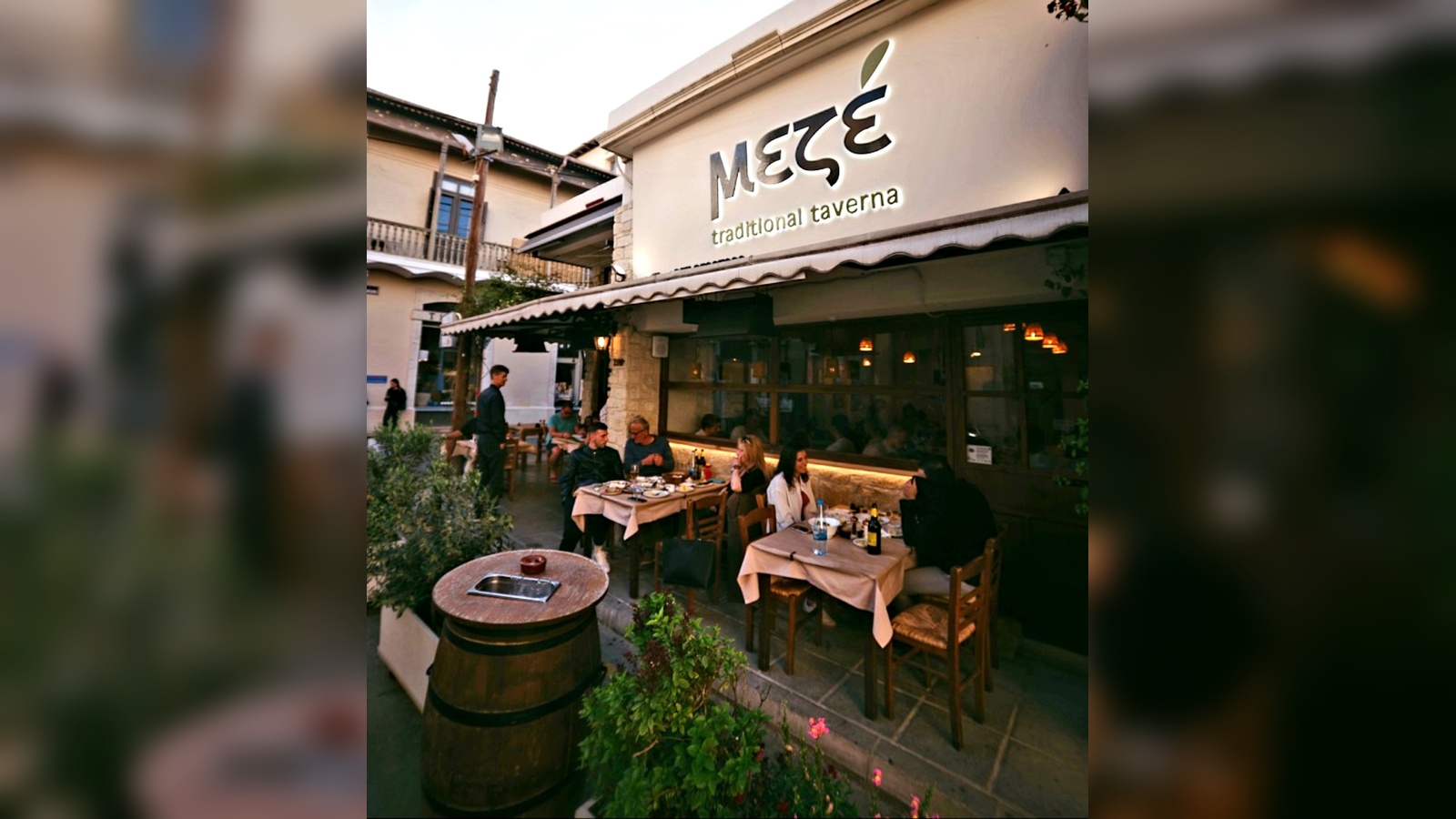
Both countries embrace meze culture.
However, the experience often differs.
In Greece:
Meze frequently acts as a collection of smaller dishes shared casually.
In Cyprus:
Meze often becomes an event.
A traditional Cypriot meze can include:
The meal can last several hours.
For visitors exploring traditional taverns in Cyprus, the scale of a true Cypriot meze is often surprising.
Cyprus has developed numerous dishes that rarely appear in Greece.
These include:
Small grilled sausages wrapped in caul fat.
Pork cooked in red wine and coriander.
A traditional wheat and yoghurt soup.
Taro root cooked in tomato-based stews.
Cypriot-style stuffed vine leaves.
Many dishes also incorporate cinnamon into savoury cooking, reflecting Middle Eastern influences rarely seen to the same extent in Greece.
Both countries take coffee seriously.
Very seriously.
In Greece, freddo espresso and freddo cappuccino dominate modern café culture.
In Cyprus, coffee culture combines:
The result is a café scene that feels familiar but slightly different.
Both cultures value conversation over speed.
Nobody rushes coffee.
A coffee meeting can easily last two hours.
One reason many visitors fall in love with Cyprus is the pace of life.
While modern cities like Limassol have become increasingly international, much of the island still operates according to traditional rhythms.
Lunch can become an afternoon event.
Coffee becomes a social gathering.
Family obligations often take priority over strict schedules.
Greece shares many of these traits.
However, Cyprus often feels even more relaxed.
Island life creates its own rhythm.
People tend to know one another.
Communities remain tightly connected.
Relationships often matter more than efficiency.
Another noticeable difference appears in business.
Cyprus has developed into a major international business hub.
The island attracts companies from:
This has created a highly international business environment.
Limassol in particular feels very different from many Greek cities.
English is commonly used.
International finance plays a major role.
Foreign residents form a substantial part of the population.
This global outlook has helped shape modern Cypriot identity.
Both countries attract millions of visitors.
However, the tourism experience differs significantly.
Known for:
Known for:
Cyprus also benefits from a longer tourism season due to its warmer climate.
Many visitors arrive throughout winter while much of Greece experiences a quieter off-season.
Absolutely.
They share:
Yet Cyprus has evolved into something uniquely its own.
The island absorbed influences from East and West.
Ottoman traditions mixed with Greek heritage.
British systems blended with Mediterranean culture.
Middle Eastern flavours found their way into local cuisine.
What emerged was not a smaller version of Greece.
It was Cyprus.
When comparing Greece vs Cyprus, the easiest mistake is assuming they are the same.
They are not.
They are connected by history, language and faith, but shaped by very different experiences.
Greece provides the cultural roots.
Cyprus adds centuries of additional influences, creating an identity that feels both familiar and distinct.
Perhaps the best way to describe the relationship is this:
Greece and Cyprus are cultural siblings.
They share the same family history, speak the same language and recognise many of the same traditions.
But each has developed its own personality.
And that is precisely what makes exploring both countries so rewarding.